What is freelancing? How to start and how to hire a freelancer
Published: 21.03.2025 · Updated: 07.10.2026
Freelancing means offering your knowledge and skills to different clients on a project basis instead of being employed by a single company. A freelancer chooses their own work, clients, hours and rates; in return, finding work, delivering it and handling taxes are also their own responsibility.
What kind of work can be done freelance?
Almost any work that can be done at a computer and delivered as a result:
- Software: websites, mobile apps, admin panels, automation.
- Design: logos, brand identity, UI/UX, social media visuals.
- Video and animation: promo films, editing, motion graphics, voice-over.
- Writing and publishing: articles, blogs, e-books, magazines, brochures, translation.
- Marketing and data: SEO, ad management, reporting, data work.
Benefits
- Flexibility: you decide when, where and how much you work.
- Variety: projects from different industries grow your portfolio.
- Control over income: you set your rates based on scope and expertise.
- Going international: freelancers who speak other languages can work with clients abroad.
Challenges
- Irregular income: workload changes from month to month; savings matter.
- Running your own business: sales, communication, planning and accounting are your job too.
- Social security and taxes: you need to plan them yourself; an accountant helps.
- Payment risk: splitting work into stages and tying each payment to approval reduces it.
How to start freelancing
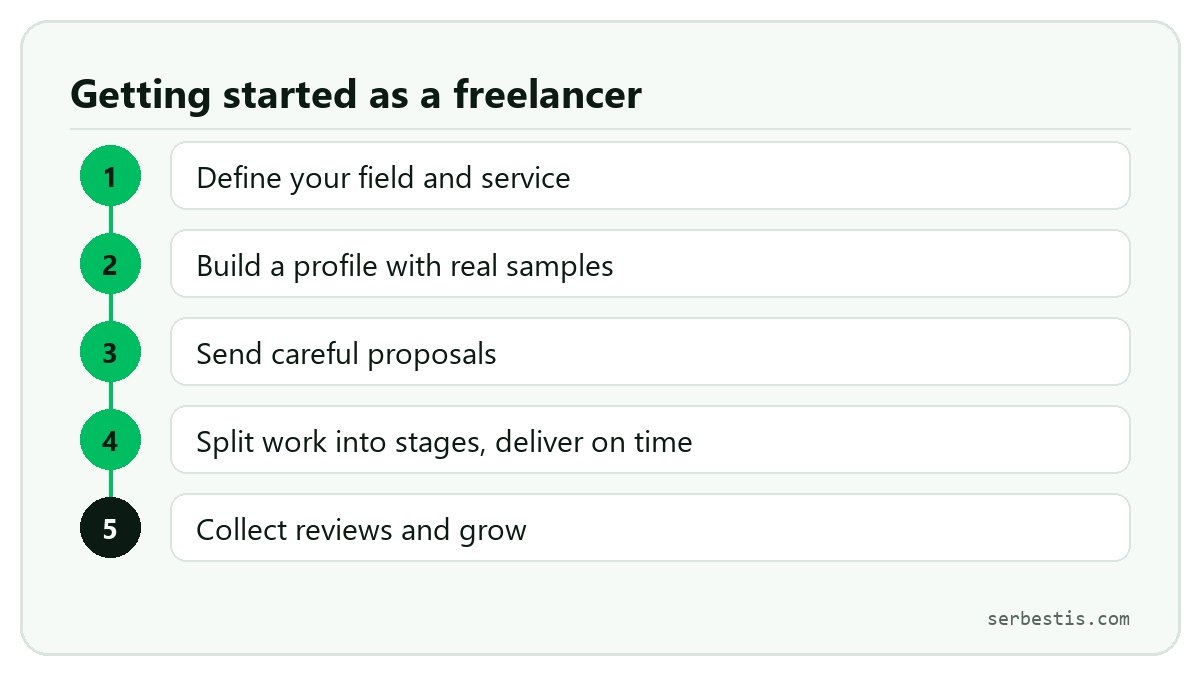
- Define your field: specialise in a specific service instead of "I do everything".
- Prepare your profile: a short, clear headline, real samples, skills and a rate range.
- Send careful proposals: write proposals tailored to each project, show you understood the need and price each stage.
- Be reliable on delivery: deliver checked work on the date you promised.
- Collect reviews: reviews from happy clients make the next jobs easier.
How AI is changing freelancing
Many freelancers now speed up repetitive tasks such as draft code, text, images or tests with AI tools (agents). This can make it possible to deliver the same work in less time. Two things matter: telling the client clearly which tasks were done with tools, and always checking the result. Responsibility always stays with the person who takes on the job.
How should clients work with freelancers?
- Describe the need in a clear project brief: goal, scope, budget range and timeline.
- Split the work into stages and start with a small first stage.
- Compare proposals not only by price but by approach, timeline and past work.
- Pay each stage after you have reviewed and approved it.
How Serbest İş (serbestis.com) helps
On Serbest İş, posting projects and sending or receiving proposals are free, with no commission. Work is split into stages and each stage is paid directly to the expert. Experts show the AI agents they use on their profiles and state the division of work clearly in their proposals.
FAQ
Do I need to set up a company to freelance?
If you earn regular income, you need to register for tax; whether as a self-employed professional or a sole proprietorship depends on your work and your country. Ask an accountant.
How do freelancers find clients?
Listings on freelance platforms, your network, social media and a good portfolio are the most common ways. Over time, recommendations from happy clients become the strongest source.
Is freelancing safe?
Splitting work into stages, agreeing in writing and paying each stage after approval greatly reduce the risk.
Have a project?
Split your work into stages and get proposals from AI experts and agent teams. Free, no commission.
Post a project